How to Securely Handle Multi Branch Database Schemas in a School Management System
Introduction
As schools grow and expand into multiple campuses, managing data becomes much more challenging. A school with one branch can often operate with a simple database structure, but once multiple branches are involved, things become more complicated. Student records, teacher information, attendance, fees, examinations, and reports must all be organized properly while ensuring that each branch only accesses its own data.
This is where a well-designed multi branch database schema becomes critical. Without proper planning, schools can face serious problems such as data leaks, reporting errors, performance issues, and security risks. A poorly designed system may allow one branch to view another branch’s confidential information, which can create operational and legal concerns.
In this guide, you will learn how to securely design and manage a multi branch database schema for a school management system. We will cover database architecture, branch isolation, security strategies, user permissions, performance optimization, and long-term scalability. You will also see practical examples that can be applied in real-world school management software.
Whether you are building a new school ERP, upgrading an existing platform, or planning a large educational management system, this guide will help you create a secure and efficient database structure that supports multiple branches without compromising performance or data protection.
Understanding Multi-Branch School Database Architecture
What Is a Multi-Branch Database Schema?
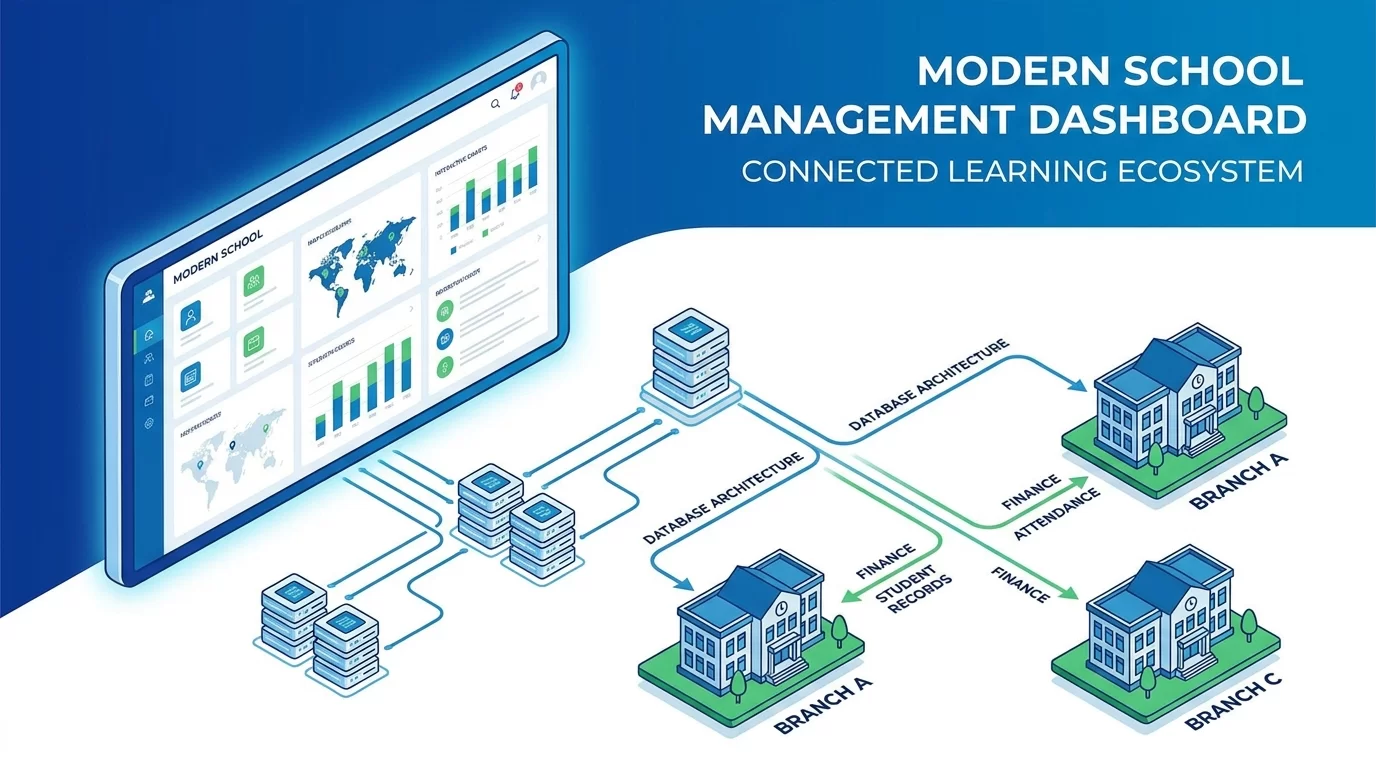
A multi-branch database schema is a database design that allows multiple school branches to operate within a single system while keeping their data logically separated.
For example:
- Branch A manages its own students.
- Branch B manages its own teachers.
- Branch C manages its own fee records.
Although all data exists within one system, proper controls ensure each branch only accesses authorized information.
Why Schools Need Branch-Based Data Separation
As educational organizations expand, centralized management becomes necessary.
Benefits include:
- Unified administration
- Centralized reporting
- Easier maintenance
- Reduced infrastructure costs
- Consistent data management
However, security and access control must be implemented correctly.
Without branch separation:
- Student data may be exposed.
- Financial reports can become inaccurate.
- Staff may access unauthorized records.
This makes database architecture one of the most important parts of a school management system.
Choosing the Right Database Structure
Single Database with Branch Identifier
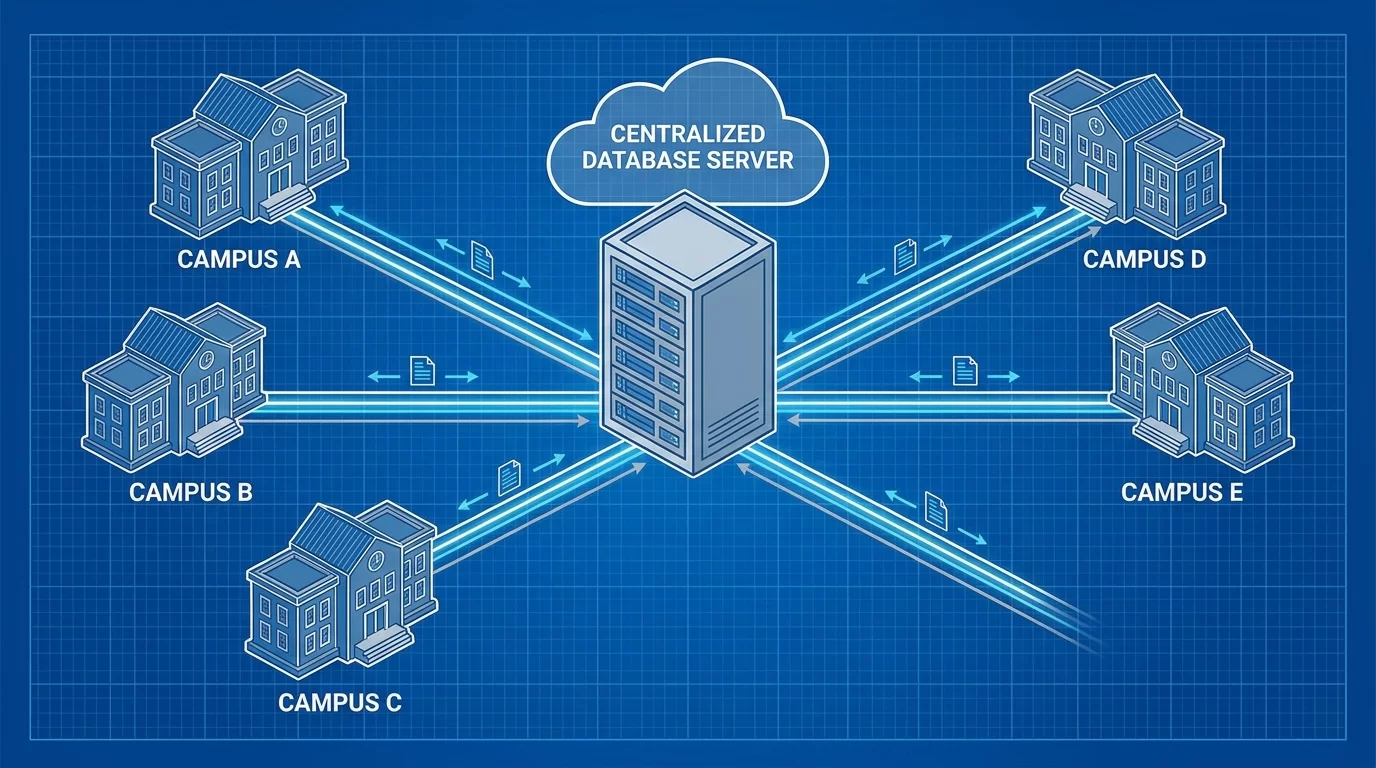
The most common approach uses a shared database.
Example:
CREATE TABLE students (
    student_id INT PRIMARY KEY,
    branch_id INT,
    student_name VARCHAR(255)
);
Each record contains a branch identifier.
Advantages:
- Easier maintenance
- Lower hosting costs
- Centralized backups
- Simpler reporting
This model works well for most school management systems.
Separate Database for Each Branch
Some organizations use independent databases.
Example:
branch_1_db
branch_2_db
branch_3_db
Advantages:
- Stronger isolation
- Improved security
- Independent backups
Disadvantages:
- Higher maintenance
- Complex reporting
- More infrastructure costs
Most growing schools prefer the first approach because it balances efficiency and scalability.
Designing Core Tables for Multi-Branch Systems
Branch Table
Every system should start with a branch table.
Example:
CREATE TABLE branches (
    branch_id INT PRIMARY KEY,
    branch_name VARCHAR(255),
    address TEXT
);
This becomes the foundation for all relationships.
Student Table
Every student must belong to a branch.
CREATE TABLE students (
    student_id INT PRIMARY KEY,
    branch_id INT,
    student_name VARCHAR(255)
);
Teacher Table
CREATE TABLE teachers (
    teacher_id INT PRIMARY KEY,
    branch_id INT,
    teacher_name VARCHAR(255)
);
Fee Records Table
CREATE TABLE fees (
    fee_id INT PRIMARY KEY,
    branch_id INT,
    student_id INT,
    amount DECIMAL(10,2)
);
Adding branch_id to every major table ensures proper data separation.
Implementing Secure Access Control
Role-Based Permissions
Not every user should access all branches.
Example roles:
- Super Admin
- Branch Admin
- Teacher
- Accountant
- Student
Each role receives different permissions.
Branch-Level Restrictions
When a branch administrator logs in:
SELECT * FROM students
WHERE branch_id = 5;
The system automatically filters data.
This prevents accidental access to records from other branches.
Session-Based Security
Store branch information after login.
Example:
$_SESSION['branch_id'] = 5;All database queries then use this value.
This adds an extra layer of protection.
Protecting Student and Financial Data
Data Encryption
Sensitive information should be encrypted.
Examples:
- Passwords
- Parent contact details
- Payment records
Never store sensitive data in plain text.
Secure Database Connections
Always use:
- SSL connections
- Secure APIs
- HTTPS communication
This protects data during transmission.
Audit Logs
Track important actions.
Example:
CREATE TABLE audit_logs (
    log_id INT PRIMARY KEY,
    user_id INT,
    action TEXT,
    created_at TIMESTAMP
);
Audit logs help detect misuse and unauthorized activity.
Handling Reports Across Multiple Branches
Branch Reports
Each branch can generate:
- Attendance reports
- Fee reports
- Exam reports
- Staff reports
Filtered by branch_id.
Centralized Reports
Head office often requires combined reporting.
Example:
SELECT SUM(amount)
FROM fees;
This provides total revenue across all branches.
Performance Considerations
As data grows:
- Use indexes
- Optimize queries
- Archive old records
These practices keep reporting fast and efficient.
Pro Tips for Building a Reliable Multi-Branch School System
A successful school management system depends on planning ahead.
Here are practical recommendations:
- Add branch_id to all major tables.
- Use foreign key relationships.
- Create role-based access controls.
- Maintain detailed audit logs.
- Schedule automatic backups.
- Use database indexing.
- Encrypt sensitive information.
- Separate development and production databases.
Always assume the system will grow.
A database supporting three branches today may need to support fifty branches in the future.
Designing with scalability in mind saves significant redevelopment costs later.
Another valuable tip is documenting every database relationship. Clear documentation helps future developers understand the system quickly and reduces implementation mistakes.
Common Mistakes to Avoid
Many developers make errors when building multi-branch school systems.
Missing Branch Identifiers
Without branch_id fields, separating data becomes difficult.
Always include branch references.
Hardcoded Permissions
Avoid manually coding permissions throughout the application.
Use centralized role management.
Ignoring Database Indexes
Large school systems generate massive datasets.
Without indexing:
- Reports slow down
- Queries become expensive
- User experience suffers
Sharing Administrator Accounts
Each administrator should have unique credentials.
Shared accounts reduce accountability.
Poor Backup Strategies
Backups are often ignored until disaster occurs.
Automate backup procedures from the beginning.
Avoiding these mistakes dramatically improves system reliability.
Advanced Strategy: Building a Scalable Multi-Tenant School Architecture
As school organizations continue expanding, database design becomes increasingly important.
Many modern educational systems adopt a multi-tenant architecture.
In this model:
- One application serves all branches.
- Branch data remains isolated.
- Infrastructure costs stay lower.
Key strategies include:
Row-Level Security
Modern databases can automatically restrict records based on branch access.
This adds protection beyond application code.
Database Partitioning
Partition large tables by:
- Branch
- Academic year
- Region
Benefits:
- Faster queries
- Better performance
- Easier maintenance
Read Replicas
For reporting-heavy systems:
- Primary database handles writes.
- Replica databases handle reports.
This reduces server load.
Centralized Monitoring
Monitor:
- Query performance
- Login activity
- Storage growth
- Failed access attempts
Early monitoring helps prevent larger problems.
Organizations planning long-term growth should build these strategies into their architecture from the start rather than adding them later.
This approach supports thousands of students and dozens of branches without major redesigns.
Frequently Asked Questions
What is the best database structure for a multi-branch school management system?
For most schools, a shared database with a branch_id field in major tables is the best solution. It simplifies maintenance, reporting, backups, and system administration. This approach also reduces infrastructure costs while maintaining proper data separation. Larger organizations with strict compliance requirements may choose separate databases, but a shared database design is generally more practical and scalable.
Why is branch-level access control important?
Branch-level access control ensures users only view data that belongs to their branch. Without these restrictions, administrators or staff members could accidentally access confidential records from other branches. Proper access control protects student information, financial records, staff data, and operational reports while helping schools maintain security and privacy standards.
Should every table include a branch_id column?
Most operational tables should include a branch_id column. Examples include students, teachers, attendance, fees, examinations, and staff records. This field makes filtering data easier and supports reporting, security, and scalability. However, some global configuration tables may not require branch identifiers if their data applies to the entire organization.
How can schools secure sensitive student information?
Schools should combine several security measures, including encryption, role-based permissions, secure database connections, audit logging, and strong password policies. Sensitive information should never be stored in plain text. Regular security reviews and software updates also help protect student and parent data from unauthorized access.
Can a multi-branch database handle future expansion?
Yes. A properly designed multi branch database schema can support significant growth. By using branch identifiers, indexing, partitioning, optimized queries, and scalable infrastructure, the system can manage additional branches without major architectural changes. Planning for expansion early reduces future development costs and operational challenges.
How often should backups be performed?
Backups should be automated and performed regularly. Most school systems benefit from daily backups, while critical environments may require hourly backups. Backup strategies should also include off-site storage, testing restoration procedures, and maintaining multiple recovery points to protect against hardware failures, accidental deletions, or cyberattacks.
Also Read